
Gen Z Chat in Ciphers, Not Emoji
A friend sent me a message ending in a skull emoji. I sent back a laughing-crying emoji. Then I realized we were reading the same characters as two different languages. This is what emoji ciphers look like in 2026.

Lois Chen·Emoji culture researchers + platform-specific guides writers·July 12, 2026
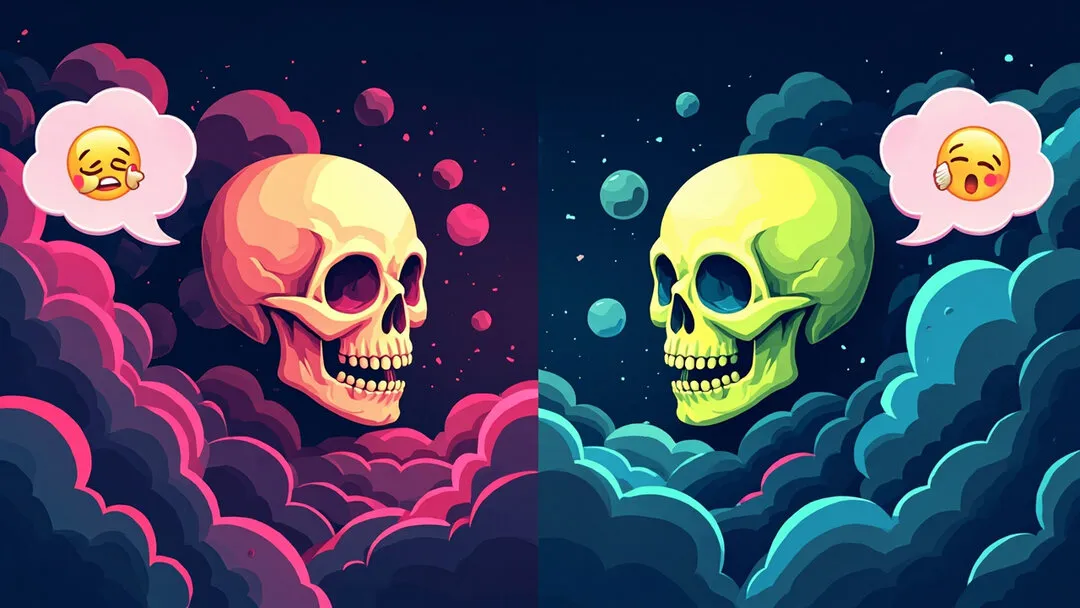
A friend sent me a message last week. It ended in a skull emoji.
I replied with a laughing-crying emoji. He said "I am dead".
Then I realized he has a job now. The skull in his context meant "I want to clock out but I have not finished". Not literal. Not "I am dead laughing".
My laughing-crying emoji, in his reading, was probably the equivalent of a primary-school essay saying "today was such a happy day".
This is the emoji generation gap.
It is not a question of which emoji are ugly or which ones should be retired. It is that the same emoji system is being used as two different grammars by two different groups.
Gen Z emoji are ciphers, not expressions
When emoji first came out, people used them to replace emotion marks in text.
"I am here 😊" "So touched 🥹" "Haha 😂"
Gen Z broke that game open.
The skull emoji in Gen Z context originally meant "dying of laughter", but it has split into at least three uses: collapse, surrender, and "this is too real for me to say anything".
Same emoji, three meanings. Anyone who cannot read them is automatically out.
The crying-laughing emoji is worse. Gen Z uses it for extreme resonance, not crying. It means "so accurate" or "I feel that". Older people see that emoji and ask "what is wrong". The answer might be "nothing, the video you just mentioned was hilarious".
The screaming-cat emoji is yet another layer. The cat-with-the-open-mouth face in fan and anime-adjacent circles means "I am shocked", but which kind of shocked depends on context.
One sentence: Gen Z emoji is encrypted chat, not emoji packs.
The cipher got harder to break when abstract-speak arrived
If you thought emoji was already complicated, Gen Z added another layer: abstract-speak.
Abstract-speak is not gibberish. It is a rule-based replacement cipher.
For example: wilted-flower means breaking up, broken-heart means heartbreak, but wilted-flower in some contexts feels more "real" than broken-heart, because broken-heart is too direct. Wilted-flower has an artistic register that signals in-group.
Another example: the finger-heart-hand means money in Gen Z, a hand-gesture version of cash that is more discreet and rolls off the tongue easier than the money-bag emoji.
The logic of abstract-speak is: the less the symbol looks like its original meaning, the better it filters out outsiders.
You do not get it, so you are not in this circle.
You get it, so you can hang.
This mechanism upgrades emoji from "expressing emotion" to "social identity authentication".
Emoji retirement: a TikTok identity game
There is a long-running meme on TikTok: announcing that an emoji has "retired".
"The crying-laughing emoji is officially retired. This year we are using laughing-crying plus black-heart."
"The skull emoji is the previous generation emoji now. The current one is shaking-face."
The retirement is not a real standard. It is an identity claim: I know this trend, I am the kind of person who just started using this emoji.
Every time you announce an emoji has retired, you are also announcing: I am caught up.
Brands doing emoji marketing fall into this trap easily. They spend real money on a "young people are using this" emoji set, and the target audience has already decided it is out of date.
The emoji gap is a real pain point, not me being dramatic
Soul App published a 2024 study with 3,064 respondents, focused on Gen Z online social etiquette.
One of the conclusions was direct: cross-generational emoji use differences are a real friction point.
A 1970s-born user sends you a rose emoji. They mean "give flowers" and "good wishes".
A 1995-born user sends you a rose emoji. They might mean "thank you but I do not want to keep talking" or "I cannot continue this thread, here is an exit ramp for you".
Both sides think the other gets it. Neither side fully gets it.
This friction happens every day in text chats. People rarely talk about it out loud.
Two drivers behind the emoji evolution
Why did emoji evolve into these generational differences?
Driver one: expression efficiency.
Text is too slow in digital conversations. A sentence like "I am really tired but I cannot show it because that would make me look weak" can compress into an upside-down-face.
Gen Z processes several times more text per day than the previous generation. Compression is a necessity.
Driver two: circle identity.
Emoji is not only an emotion symbol. It is a circle-membership authentication system.
When you use specific emoji combinations, you signal that you know the meme origin, you know how to respond in context, you know the unspoken rules of the circle.
This system grows in any circle with enough social density. Gen Z just put it onto emoji.
Is your emoji caught up?
Saying all this is not asking you to learn every Gen Z cipher.
It is asking you to realize: the emoji you send might be read as something other than what you meant.
The same crying-laughing emoji carries a different emotional intensity to different readers.
The same skull emoji is a different level of collapse across generations.
Before you send the next message, ask yourself one more time: how will the other person read this?
If you are not sure, there is a tool that can help you check.
Forgemoji has a scene called "Read Gen Z". It translates emoji combinations into the meanings they tend to carry in different contexts.
Pick two emoji and see what the combination most commonly reads as.
You do not need to learn every cipher. You just need one more channel of confirmation before you hit send.
Send the wrong emoji pack and you risk a small awkward moment. Send it at the wrong moment and you risk social death.
Want to check how an emoji combination reads before you send it? The Forgemoji Gen Z scene lets you iterate in seconds.
Try the Gen Z scene →Frequently asked questions
Do Gen Z actually use emoji differently than millennials?
Yes, and the gap is wide enough that the same emoji can flip polarity. Skull, crying-laughing, slight-smile, thumbs-up, smirk are all places where Gen Z reading and millennial reading diverge enough to cause real miscommunication.
Will emoji ever stop being a moving target?
No. The cipher moves because the cohorts driving adoption move. Each year a new cohort ages into the platforms that drive emoji use. Each year a small set of new emoji moves into the active cipher. The handful that survive tend to share a few traits: they fill a gap, they work standalone, they get adopted by a high-density platform.
How do I avoid sending the wrong emoji at work?
Default to older-reading emoji on professional platforms. The smiley, the heart, the thumbs-up all read as sincere on both sides of the gap. Skull, shrug, pleading-face, slight-smile all carry real cross-generational risk on a work channel. When in doubt, send the caption without the emoji.
Should I learn the new Unicode emoji each year?
No. Most die inside eighteen months. The handful that survive will surface in your regular feeds within a year, and your cohort will signal which ones are worth picking up. Trying to learn all sixty each January is a losing strategy. Watching what survives the first six months is a winning one.
Lois Chen·Content editor
Reviewed July 12, 2026
How we wrote this: Blog posts are written from first-hand platform testing (Discord servers, Telegram groups, TikTok), interviews with power users in r/discordapp and the Telegram sticker community, and weekly checks of Unicode release notes. Every guide is reviewed by at least one editor for technical accuracy and updated when the platform in question changes its rules. Emoji usage data is gathered from public Google Trends, UDF (Unicode emoji frequency) reports, and our own Forgemoji generation logs.
Sources: Forgemoji internal editorial team — see About page for individual contributor notes